5) Homogeneous Catalysis
Selected relevant aspects include:
* Activation and Conversion of CO2 into a higher added value d-lactone by telomerization with butadiene, using a Pd(II) catalyst which was the first metal complex to allow reversible CO2 fixation under ambient conditions through C-C bond formation (J. Am. Chem. Soc. 1981, 103, 5115; J. Am. Chem. Soc. 1988, 110, 3207). See Chem. Rev. 1988, 88, 747.
* Bifunctional and Recyclable Polyesters by Chemoselective Ring-Opening Polymerisation of a δ-Lactone Derived from CO2 and Butadiene (J. Zhang, L. Jiang, S. Liu, J. Shen, P. Braunstein, Y. Shen, X. Kang, Z. Li, Nature Comm., 2024, 15:8698.
* Alkane activation with neutral phosphinoenolate Rh(I) complexes which are soluble in neat alkanes (Organometallics 1996, 15, 5551).
* Synthesis of very active Ru complexes for hydrogenation transfer of ketones using functional phosphinooxazoline ligands (J. Chem. Soc., Dalton Trans. 1999, 589).
* Synthesis of homogeneous Fe-Pd and Fe-Ni bimetallic catalysts which were the most active catalysts known for the dehydrogenative coupling of stannanes (see Chem. Rev. 2000, 100, 3541).
* Pd-promoted coupling of ethylene, CO and functional monomers (Angew. Chem. Int. Ed. 2000, 39, 2867).
* Double C-Cl activation of CH2Cl2 promoted by cobalt or nickel phosphine complexes, leading to transfer of the CH2 group to phosphorus (Chem. Commun. 2009, 890; Organometallics, 2015, 34, 2255).
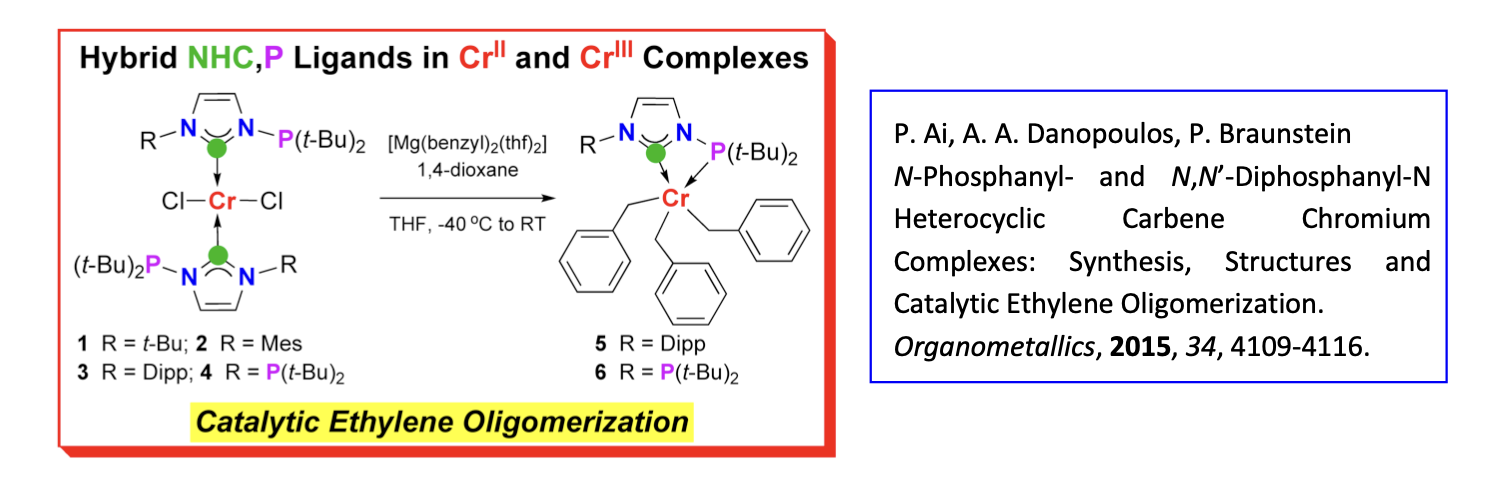
* Ethylene oligomerisation: a long-standing collaboration with the Institut Français du Pétrole (now IFP Energies nouvelles), has focused on catalysts for the selective oligomerisation of ethylene to give short-chain α-olefins (Acc. Chem. Res. 2005, 38, 784; Chem. Commun. 2014, 50, 1398-1407 (Feature article); Organometallics, 2016, 35, 4044-4049; Dalton Trans., 2019, 48, 12895-12909; ChemCatChem, 2021, 13, 2167–2178; Dalton Trans. 2022, 51, 11226–11230).
 *Click on the figure to see the Cover Gallery corresponding to this section.