2) Functional Ligands, Hemilability, Metal Complexes and Applications
The development of new polytopic phosphorus ligands and their corresponding metal complexes has enabled comprehensive studies on selective coordination to transition metals, and their often dynamic and hemilabile behaviour. Beyond the fundamental aspects of this research, the reversible coordination of small molecules (e.g., CO and CO₂) was studied and applications in homogeneous catalysis were investigated.
Rare monohapto-h1-allyl Pd(II) complexes were characterised, which allowed the determination of the conditions for their occurrence. Their enhanced reactivity compared to that of the ubiquitous h3-allyl complexes is directly relevant to several catalytic transformations involving allyl intermediates (Organometallics 2001, 20, 2966; J. Chem. Soc., Dalton Trans. 2003, 507).
Furthermore, phosphino-enolate complexes have demonstrated versatile applications in homogeneous catalysis. These include the palladium-catalysed telomerization of CO₂ and butadiene, the nickel-catalysed ethylene oligomerisation, the rhodium-catalysed alkane activation, and the ruthenium-catalyzed transfer hydrogenation.
The introduction of silicon ligands into bimetallic chemistry has yielded numerous unexpected developments. Key breakthroughs include the discovery of the hemilabile bridging behaviour of alkoxysilyl ligands, the synthesis of novel metal-silylene complexes, and the observation of silyl group migration between metal centres. Furthermore, catalytic applications have expanded into the dehydrogenative coupling of stannanes, the co-oligomerisation of olefins with carbon monoxide, and sol-gel chemistry.
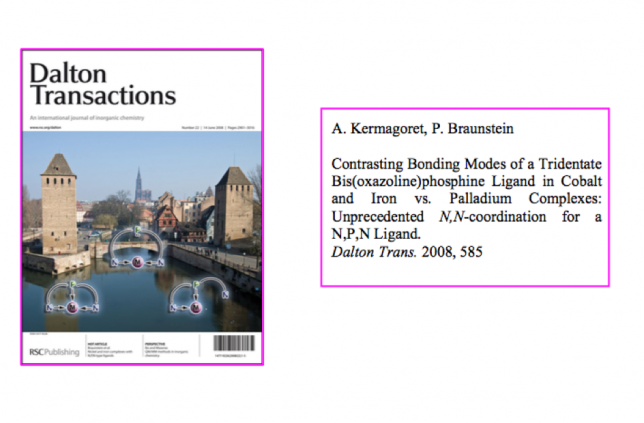
*Click on the figure to see the Cover Gallery corresponding to this section.